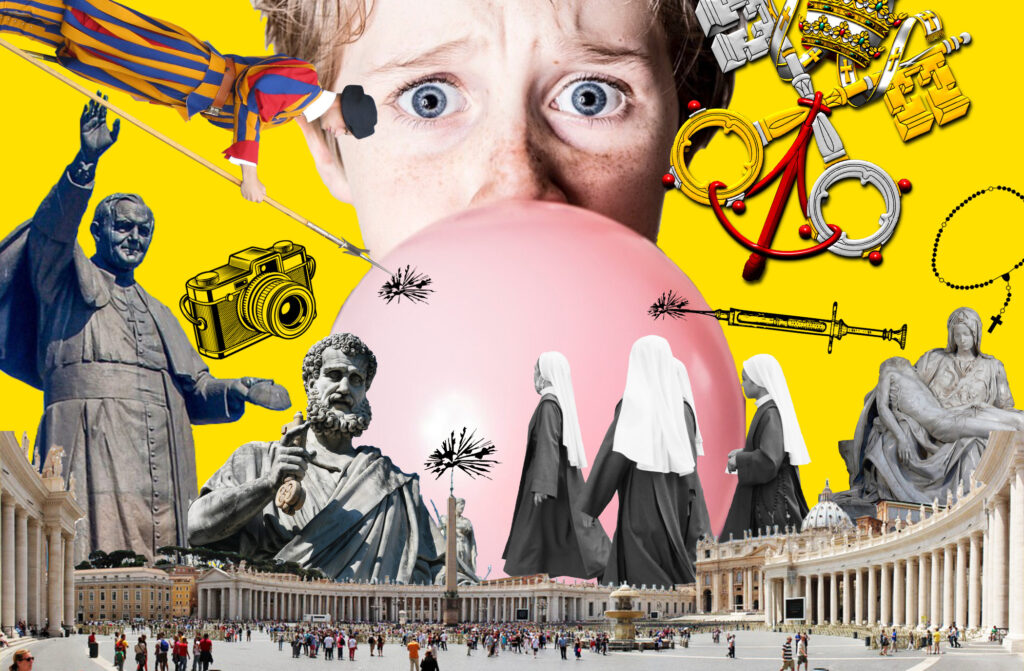
During my lifetime, there have been six popes, including the recently deceased Pope Francis, the 266th head of the Roman Catholic Church, and his successor, Pope Leo XVI. When I started writing this article, Pope Francis was still alive — so technically, I write slower than the Vatican elects popes. When I was old enough to grasp what a Pope was (some kind of religious CEO, as far as I understood), it was Pope John Paul II at the helm. He seemed nice enough, at least through the lens of someone who knew little about Catholicism beyond the fact that popes wore big hats and waved from balconies. This was also before I became aware of the Church’s…let’s say questionable stances on a wide range of issues.
I bring this up because, in my early tweens, after enough border crossings to earn honorary airline status, my family and I landed back in Europe, fully convinced it was just a scenic layover on our epic quest to reach Canada—eventually. We eventually made it to Rome, lured by rumours that the Canadian embassy there was handing out golden tickets to Toronto. What followed was six months of pure Roman chaos; equal parts bureaucracy, gelato, and mild existential crisis.
But, before we get into that, a little more necessary backstory.

When we first arrived in Rome, we did all the classic touristy things—but with a twist. Our mom, a devout Catholic, took it upon herself to become our unofficial pilgrimage tour guide. This meant we didn’t just sightsee; we church-saw. If you think Rome runs out of churches, think again. Think shopping spree, but holy — instead of bags, you leave with a sore neck from all the frescoes and enough crucifixes to bless a small village.
Most churches in Rome have a park nearby, and after each visit, we’d crash on a bench to snack and recover from yet another deep dive into stained glass and saints. Sounds idyllic, right? Well, here’s where things took a turn: my parents quickly noticed that many of these parks were, let’s say, accessorized—with syringes. Just casually scattered around, like some kind of grim confetti. Cue full-blown parental panic. Rome wasn’t just the Eternal City—it was The Eternal City: Needles & Nightmares Edition. So, in a move that can only be described as “classic panicked parents,” they decided we should relocate just outside of Rome to Lido di Ostia. Surely, no one did drugs there — because nothing says ‘drug-free’ like a sleepy beach town full of bored teenagers.
So every day, we’d take the hour-long train back into Rome, which was just enough time for me to make a truly groundbreaking discovery: my little sister had somehow mastered the sorcery of blowing bubble gum bubbles. I, on the other hand, had not. Thus, our train rides became a crash course in Bubble Blowing 101—her as the smug professor, me as the hopeless student. Let’s just say my success rate was lower than the number of churches we’d been dragged to. And considering our mother’s enthusiasm for holy landmarks, that was really saying something.

Then one fateful day, Mom, practically vibrating with excitement, announced that we were off to a very special place—the grandest church of them all! My sister and I exchanged a look. My sister and I traded a look that said, Wonderful. Another church. Maybe this one will finally break us.
Big or not, it was still just a church, and at this point, we were racking up holy landmarks like some kind of reluctant pilgrimage loyalty program. That’s when Dad, ever the prankster, grinned and said to us, “Come on, we’ll meet the Pope. Maybe he’s got candy.” Now, keep in mind, Dad was about as religious as a lawn chair, but the mention of candy had our full attention. If the Pope was handing out sweets, we were willing to listen. Little did we know…
And then we stepped into St. Peter’s Square.
Massive doesn’t even begin to cover it. It was the kind of space that makes you question your own existence, the kind that reminds you that in the grand scheme of things, you’re a tiny, insignificant speck—especially when you’re a kid. The square wasn’t crowded that day, which only made it even more overwhelming, like it had all the space in the world to swallow us whole. I tilted my head back, eyes widening as I took in the statues—dozens of them perched on the colonnades like an army of gargoyles in human form, staring down in eternal, silent judgment. Later, I learned they were saints — all 140 of them — sculpted by Bernini, the Vatican’s golden boy in the 17th century. At the time, though, all I could do was stand there, slack-jawed, my gum hanging on for dear life. I half-expected one of them to bend down and mutter, ‘Cosa stai guardando, ragazza?” What are you looking at, girl? That’s when my mom, already clutching my little sister’s hand, grabbed mine and yanked me forward. Without missing a beat, she said, “Let’s go. And close your mouth.” Welcome to the Vatican.
We crossed the square and stepped into St. Peter’s Basilica, where my jaw promptly hit the floor again. This place wasn’t just big. It was ridiculously big. The kind of big that makes you wonder if you’ve accidentally wandered into heaven’s lobby. Everywhere I looked—art, statues, gold. So much gold. It was like someone had handed Bernini an unlimited budget and said, “Go nuts.” This time, my mom didn’t even have to say anything—just one sharp, knowing look, and my jaw snapped shut like a trap. I went back to chewing my gum, trying to act casual. Big mistake.
The basilica was silent. The kind of silence that makes even the faintest sound feel obnoxiously loud. And my enthusiastic gum-chewing? Less “subtle rebellion,” more “echoing like a construction site.” We had barely stepped inside when—without warning—my mom shoved my little sister into my dad’s arms, grabbed my wrist, and yanked me aside. From the depths of her purse, she produced a cloth napkin with all the dramatic flair of a magician about to perform the grand finale. Then, in the loudest whisper known to mankind (a true parent superpower), she delivered the verdict:
“Spit.” I gasped, scandalized.
“BUT?!” She didn’t flinch. She had trained for this moment.
“Spit. It. Out. You don’t chew gum in here.”
“BUT?!” There was no but. There was only the napkin.
“You’re not at home. We need to be respectful.” And that was that. No arguments, no negotiations. I sighed, accepted my fate, and reluctantly surrendered my gum into the napkin of doom, even though I was sure I had been on the cusp of blowing a bubble, my first one, my world crumbling.
We caught up with my dad and my sister, who had made a beeline for a statue that demanded attention—a sorrowful spectacle frozen in stone. A woman in flowing robes, hair hidden beneath a veil, sat with an air of calm resignation as if she’d long since made peace with whatever tragedy had landed in her lap. And in her lap, quite literally, was a man so emaciated he looked like he’d lost a fight with famine. A scrap of cloth preserved his dignity, but his limp, lifeless form radiated nothing but sorrow and finality. Right on cue, Mom crossed herself. I knew exactly what was going on. My sister, though, had no clue — she looked at me, shrugged, and pointed at the statue:
“Who are they?” Mom, thrilled that someone was finally engaging with the art (while Dad was still hypnotized by the gold-plated everything), knelt down like she was about to reveal a major plot twist.
“That’s Jesus. And his mother, Mary.” My sister stared. Squinted. Tilted her head. Then, with the brutal honesty only a small child can deliver, said,
“He doesn’t look good.” Mom didn’t miss a beat.
“He sacrificed himself.”
“For what?”
“For the world.”
“Why?” Mom took a breath. Here we go.
“Because he’s the son of God.”
“So?”
“So… he sacrificed himself for us,” Mom said, as if that clarified everything.
“Why?”
“Because… that was his fate.”
“Fate?” My sister frowned like Mom had just spoken ancient Greek. Mom scrambled.“It was, like, his job.” That landed. Sort of. My sister made a face, somewhere between confusion and deep pity. Then she said,
“Bad job,” and walked off like she had a meeting to get to.
A few steps deeper into the basilica, I spotted a group of nuns heading our way. There had to be at least six of them, gliding in perfect unison like a synchronized holiness squad. They were smiling, exuding that serene, otherworldly calm, lively yet silent, their hands across their chest and hidden by the long and wide sleeves of their habit. And then I saw it. Gum. One of them was chewing gum. Ah-ha! Hypocrisy in action! I practically sprinted over to Mom, yanking on her sleeve and pointing like I’d just cracked a major Vatican conspiracy.
“Look! She’s chewing gum!” Mom didn’t even blink. She simply slapped my pointing hand down with the reflexes of a ninja and said,
“This is their home. They can do what they want.” I gasped.
“BUT?!” Mom was already walking away.
“Shh. You’re being too loud. Let’s go.” And just like that, I trudged after her, chewing on the bitter truth instead of my gum: the world is an unfair place.

After what felt like an eternity, we finally stumbled back outside — but not before ticking off one last must-see: the Sistine Chapel, tucked inside the Apostolic Palace. Now that made an impression. I nearly fell over backward trying to take it all in without spraining my neck. Of course, it was so dimly lit (something about preserving the precious frescoes, blah blah) that half the time I wasn’t sure if I was admiring Michelangelo’s masterpiece or just my own eyelash shadows. What I didn’t know then was that this very room doubled as the Pope election HQ — the world’s fanciest voting booth.
At the Vatican exit gate, my mom saw something that lit up her eyes. She had spotted a Swiss Guard standing by one of the gates. If you don’t know who those guys are, you’re in for a treat. Switzerland has provided security for the Vatican for centuries. Not sure how the Swiss lost that coin toss, but the more interesting thing about these guys is their uniforms, which have stubbornly resisted change for hundreds of years. Think Renaissance fashion week—puffed sleeves, matching puffed pants in bold stripes of navy, red, orange, and yellow, topped off with a black beret or, on fancier occasions, a feathered helmet. And, of course, no look is complete without the ultimate medieval accessory: a halberd. Yes, a literal axe on a stick. Naturally, my mom needed a picture. She turned to my dad and asked him to snap it. Being the dutiful husband he was and the guardian of our camera, he agreed—until he noticed a slight issue. As my mom sidled up to the stoic young man, the young man subtly edged away. She took another step closer. He took another step away. It was like the world’s most dignified game of tag. Finally, in a crisp, polite tone, the guard waved her off.
“Signora, per favore.”
My dad, ever the realist, observed,
“I don’t think he wants a photo.” But my mom, ever the optimist (or perhaps just strategically hard of hearing), gave it another go. Another step. Another step back. This time, the guard firmly declared,
“Signora, non è permesso.” My dad, who always picked up languages with unsettling speed, lowered the camera and translated:
“He said it’s not allowed.” Mom sighed, disappointed but not even close to defeated. With a suspicious gleam in her eye, she leaned toward my dad and hissed,
“Count to three. Step back a bit and just take it. Fast.” In a flash, Mom darted as close to the guard as she dared, while Dad snapped the photo, praying we wouldn’t get arrested. The result? An absolute masterpiece: Mom grinning like a kid on Christmas, standing a good six feet from a guard who looks like he’d rather catch the plague than catch her smile. If I do say so myself, it’s peak Vatican tourism.