The Chairs Were Called As Witnesses
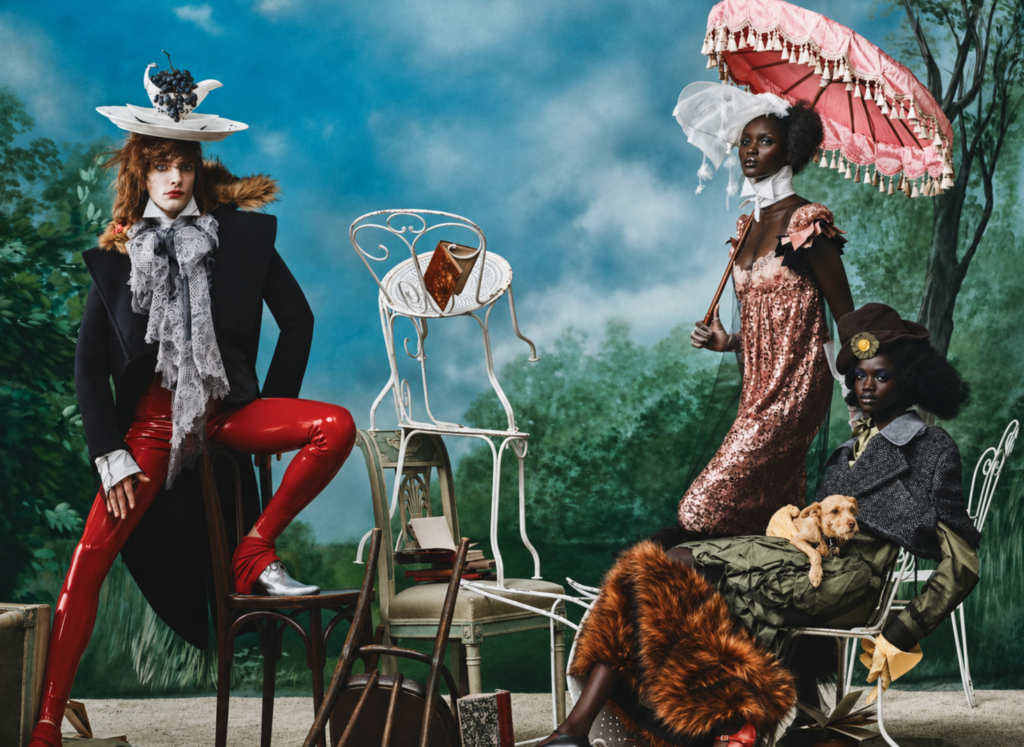
IMAGINED ELSEWHERES: Every story here begins with a picture. I look at it until some small detail starts behaving suspiciously. Then I make up what happened five minutes before, fifty years earlier, or just outside the frame. Without the picture, there’d be no story. It started the whole thing and now has the nerve to sit there looking innocent. Photograph by Rafael Pavarotti for “Vintage Galliano,” Vogue, November 2026.
“I think she owes me for the funeral.”
The first thing Aunt Ottilie did after her funeral was send three people a note asking them to put the chairs back.
There had been a gale during the service, and the good chairs had blown into the herb garden. That explained the chairs. It did very little for the notes, which were in Ottilie’s handwriting and each included a small, personal criticism.
Felix had been told to wear something cheerful. He arrived in red trousers so shiny you could see the sky in his knees. On his head he wore a porcelain gravy boat full of black grapes. Felix was a milliner. Aunt Ottilie had been his best customer and the only person who’d ever asked him to put a handle on a hat.
Cora, the village weather observer, came in a copper dress beneath a pink parasol. Ottilie had told her to expect a shower at four. At three fifty-eight, two drops fell into the gravy boat.
“Moving east,” Cora said, and made a note on her cuff.
Beatrice, who had drawn up Ottilie’s will, was already seated with a small dog in her lap. The dog’s name was Mr. Pym. The notice in the paper had described him as a devoted companion, which Beatrice considered generous. He had bitten Ottilie every Christmas for eleven years.
“Do we think she’s alive?” Felix asked.
“I think she owes me for the funeral,” said Beatrice.
They had been told to arrange the chairs according to height. Felix, who’d spent the afternoon wondering what a chair looked like when it stood on tiptoe, had put the white iron one on top of an upholstered one. From that height, Cora could see a small marbled book wedged behind its curling back.
Beatrice knew it at once. It was the household ledger. She opened it, expecting to find instructions about the silver. Instead she found entries for every Thursday going back twenty-seven years.
Felix, one hour. Cora, one hour. Beatrice, one hour.
Beside each entry Ottilie had written what the hour was for. An afternoon Felix had spent waiting for a man who never came. The hour Cora had stood at a hospital window watching snow fill the car park. The hour Beatrice had sat in her kitchen with a letter from her sister, working herself up to opening it.
“I wondered where that hour went,” Beatrice said.
“What did she want them for?” asked Felix.
Beatrice turned the page. There was a photograph of Ottilie on a beach, barefoot, with her skirt tucked into her knickers. Across the bottom she’d written, Thursday. Spent all three.
There was a little silence. Felix took a grape from his hat.
“Well,” said Cora, “I hope the water was warm.”
Mr. Pym lifted his head. Somebody was coming up the gravel path, dragging a chair. All three turned toward the sound. That was when the photographer took the picture.
Ottilie had hired him, of course. She’d paid for an hour.